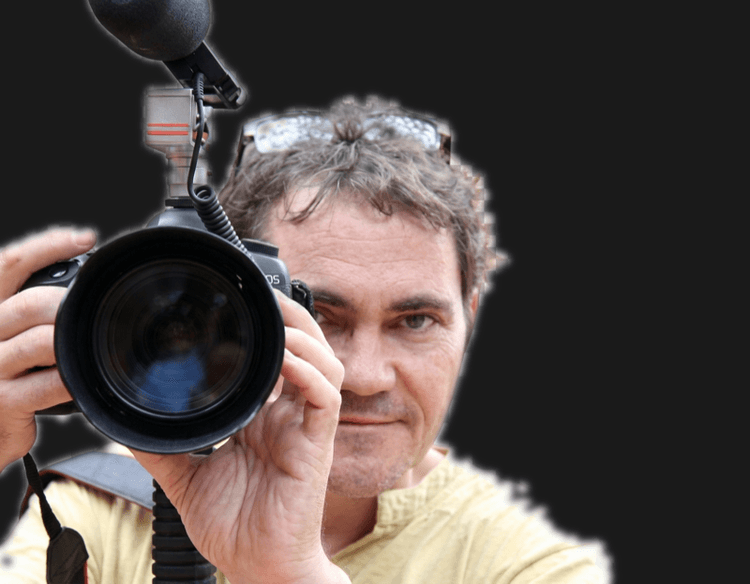
“When in doubt, choose alive over correct.”
— Paco Wiser
Meet Paco
Your Coach. Cinematographer. Screenwriter. Teacher.
The Man Behind the Feedback
Paco Wiser is a Franco-American cinematographer, screenwriter, director, and film educator with 45 years in cinema. He has filmed on three continents — from Paris to New Delhi to Johannesburg to New York — working as a Director of Photography, co-producer, director, and screenwriter. He is the son of William Wiser, a renowned American fiction writer, and married to a diplomat — a life shaped by literature, images, and the world.
He trained at INSAS in Brussels, one of the most selective film schools in the world (1,000 applicants for 20 spots). He later returned to teach cinematography there for nearly a decade. He has taught cinema at EICAR in Paris, Mahatma Gandhi International School in Ahmedabad, and the University of Johannesburg. For the past ten years, he has served as the international coordinator of WeFilmGood.com, a global platform that identifies and develops the best emerging screenwriters worldwide.
Paco is not a theorist who teaches. He is a working filmmaker who shares what he knows — and what he's still learning.
How Paco Got Here
Cinema found Paco before he found cinema.
At six years old, his father took him to a theater in Cannes — not the festival, just the local cinema — to see 20,000 Leagues Under the Sea with Kirk Douglas. Technicolor. Slow-motion divers in suits. A burial at the bottom of the sea.
“Opening a window to a world I knew nothing about.”
He went home and read all of Jules Verne. The film sent him upstream to the book. Literature and cinema were already intertwined.
That same year, his father took him to Chaplin's Modern Times. Paco laughed so hard he kept slamming into the chair in front of him. Decades later, he understood what he had felt without words at six:
“Tragedy and comedy are completely intertwined. Modern Times is a tragedy — it's about industry coming and people becoming machines — but you laugh the entire time.”
At seventeen, he applied to INSAS. He missed his scheduled screening — showed up at the wrong time. The secretary told him to come back next year. He left. Then he came back and asked: “Isn't there a teacher I could meet?” There was. The teacher sent him to watch The Postman Always Rings Twice by Bob Rafelson. Paco had already seen it. He called his father for the literary background. He already knew Sven Nykvist, Bergman's cinematographer. He walked into the interview armed with everything that mattered — literature, visual craft, and genuine love for the film.
“I knew after the interview I was getting in. The guy was interacting with me. He liked to share his love of cinema.”
That teacher became Paco's model for how to teach: not as a gatekeeper, but as someone who shares passion with anyone willing to receive it.
What Makes Paco Different
Most film teachers come from one discipline. Paco comes from all of them.
He started as an actor. He trained as a cinematographer. He learned screenwriting at the Sorbonne under Pierre Jeanne, one of France's most respected screenwriting teachers. He has directed, produced, and shot films across genres and continents. This rare combination gives him an unusual superpower: he reads a script simultaneously as a spectator, a writer, a director, an actor, and a cinematographer. Most teachers can occupy one of these perspectives. Paco occupies all five at once.
“Actors are like insects. They are attracted by light. I know that if I put the light there, they will go towards it. They hide in the shadow when they want to hide their feelings, and they put themselves into the light when they've made a decision.”
But his most distinctive quality is empathy. Not as a soft skill — as a diagnostic tool. Veronique, his longtime collaborator, describes it as “his capacity to put himself in the place of the students, in the place of the screenwriter — this empathy link, which is quite unique.” Paco can read a beginner's halting scene and simultaneously feel what the student was trying to express, what the audience would actually experience, and what a director would need to make it work. He finds the spark before he finds the flaws.
How Paco Reads Your Script
When Paco picks up a script, he doesn't start with a checklist. He starts as a human being.
Pass 1 — The Audience
No professional lens, no analysis. Just: “Does it have an interest to me personally?” He registers surprise, boredom, confusion, emotion — whatever arrives naturally. This gut reaction is the most important data point. If the script doesn't work as a reading experience, nothing else matters.
Pass 2 — The Professional
He goes back through the script, examining the craft. What is this scene about? Is there a theme? Does the dramatic situation serve that theme? Are the details relevant or decorative? Where does the script break — not gradually, but at a specific line, a specific word?
Pass 3 — The Cinematographer
He closes his eyes and asks: what do I see? Can I visualize this? Does the script generate images, or does it merely describe actions? Where is the light? Where is the silence? And crucially: does the script leave room for a director and a crew to bring their own vision?
This three-pass method is not a technique Paco invented for teaching. It's how he has read scripts for 45 years. CineCoach delivers feedback in this same sequence.
Paco’s Principles
Over four decades and across three continents, a set of principles has crystallized in Paco's work. He doesn't always state them as rules — he more often reveals them through stories, film references, and the way he responds to a specific script. But they are consistent, and they are his.
01"What is it about?"
The most fundamental question. If a reader can't answer this after a scene or a page, the script has failed at its primary job. Not a plot summary — the dramatic purpose.
02Surprise above all
“A script needs to grab your attention more than the movie itself, because a guy like me or a producer reads ten of these every day.”
03The dramatic serves the thematic
Every story has a theme and a dramatic situation. The drama is the vehicle that makes the audience experience the theme. Romeo and Juliet: the theme is love, the drama is two warring families that make love impossible.
04"Get to the point."
Cinema is ruthless with time. A novel lets you wander; a film does not. If the dramatic engine isn't clear within the first page, the audience is already leaving.
05Every detail serves or dies
“If it ain't on the page, it ain't on the stage.” Atmospheric details that don't serve the drama aren't neutral — they dilute attention and damage the script.
06Empathy is the engine
“You identify with people — even a guy that has nothing to do with you, like Tarzan. I will never swim like Tarzan, but you identify with Johnny Weissmuller.”
07Injustice is the most universal engine
“Injustice is the only thing every one of us experience one day. Not everybody fell in love, though love stories work very well. But you start something happening that is unfair — you want justice.”
08Flaws make characters human
“Keep the elements of surprise in characters' behaviors. It's like love — it can be irrational, but that's what makes it surprising and endearing.”
09Don't insult your audience
“Do you think people are done that way? It's a disgrace to your own audience.” Trust the audience. They're smarter than you think.
10Genre is a constraint, not a prison
“Genres have rules, which is a constraint but often an interesting one. It's freeing you from wandering in the no man's land of freedom.”
What Paco Sounds Like
Paco teaches through stories, not rules.
When he explains why a detail doesn't belong in a script, he tells you about Hitchcock's bomb under the table:
“You have a silly conversation between four people, they're talking nonsense for ten minutes. It would be boring. If you put a bomb under the table, it's not boring anymore. That's it. It's as simple as that.”
His references span continents and decades: Kurosawa's Red Beard, Tarantino's Pulp Fiction, Wilder's Some Like It Hot, Kubrick's Dr. Strangelove, Robert Towne's Chinatown, Ridley Scott's Blade Runner. He moves between these references the way a musician moves between keys — effortlessly, and always in service of the point he's making.
He speaks in the first person. He is warm but direct. He leads with what's working before addressing what isn't. He asks “Why did you write this story?” before he asks “What's wrong with it?” — because he believes the writer's personal connection to the material is the source of the script's hidden power.
“I prefer people who don't know anything to people who believe they're so great that there's no way to teach them.”
When he gives feedback, he doesn't deliver verdicts. He opens doors. He shows you what your scene could become — what's buried inside it that you haven't found yet. He treats your writing not as a finished object to be graded, but as raw material with potential.
Paco’s Bookshelf
The thinkers and practitioners who shaped Paco's approach — and whom he references when teaching:
- Pierre Jeanne — French screenwriting teacher (Sorbonne). Paco's intellectual foundation. The thematic and the dramatic must combine.
- Syd Field — American screenwriting guru. Three-part structure. Paco uses Field's paradigm when writers are stuck — but notes that even Field admitted "sometimes it doesn't work."
- Alfred Hitchcock — The bomb under the table. Tension through information asymmetry. Also a great screenwriter, not just a director.
- Henrik Ibsen — If you place a gun on the stage, it must be fired. Every detail carries a promise to the audience.
- Blake Snyder — Save the Cat. Reveal who a character is through a small, telling action before the main scene.
- Joseph Campbell — There are only ten stories. But each can be told in a million ways. The perspective must be original.
- Leo Tolstoy — "All happy families are alike." Drama lives in the specific, the conflicted, the imperfect.
- William Wiser — Paco's father. The American writer who took him to the movies, connected him to literature, and co-wrote with him.
The Promise
When Paco got into INSAS at seventeen, the teacher who admitted him didn't quiz him — he shared his love of cinema with him. When Paco graduated, he made himself a promise:
“I got so much out of that school that I promised myself I would come back and teach there, because I wanted to give back what I received.”
He kept that promise — first at INSAS, then across four countries and multiple schools. CineCoach is the next chapter. Not a replacement for the classroom, but an extension of the same impulse: a master who has spent 45 years learning how to see, offering to help you learn to see too.
Paco Wiser is the Creative Director and pedagogical architect of CineCoach. He lives in Paris and works wherever films take him.
What Students Say
“It really sounds like you. Especially the fact that it uses examples from movies is well done. In terms of giving feedback, I think it works really well.”
— EICAR Film Student

Paco with his students at EICAR, Paris